

Can AI Improve ADC Linker–Payload Design and Conjugation Process Development?
Can AI Improve ADC Linker–Payload Design and Conjugation Process Development?
AI in antibody–drug conjugate development | Research insights and manufacturing implications
Meta description: Explore how generative AI and machine learning are advancing ADC linker–payload design and drug-to-antibody ratio prediction, including the limits of experimental validation and manufacturing scale-up.
Keywords: AI in ADC development; antibody–drug conjugate; ADC linker–payload design; Linker-GPT; drug-to-antibody ratio (DAR); ADC conjugation process optimization; ADC CRDMO.
Introduction: Where Can AI Add Value to ADC Development?
Antibody–drug conjugates (ADCs) are evolving toward novel payloads, more sophisticated linkers, and multi-payload architectures. These advances expand the design space while making it harder to balance potency, stability, safety, and manufacturability. ADC development still relies heavily on experimental screening and accumulated process knowledge. Artificial intelligence (AI) offers complementary tools for exploring molecular structures and learning from experimental datasets.
Recent reviews in Trends in Pharmacological Sciences, Nature Chemical Biology, and npj Precision Oncology describe AI applications in ADC design, molecular simulation, and property prediction. Two original studies—Linker-GPT and machine-learning-based DAR prediction—offer more concrete evidence of progress in specific development tasks.[1–5] The key question is how far these tools can go beyond computational promise toward experimentally validated, manufacturable ADCs.
1. Why Are Linker–Payload Design and Conjugation Difficult to Optimize?
ADC performance depends on the interplay among the antibody, linker, payload, and conjugation strategy. Components that perform well individually may behave differently when combined, potentially affecting stability, aggregation, and in vivo disposition.
A linker must provide sufficient stability in circulation while allowing payload release under appropriate biological conditions. Payload potency, solubility, hydrophobicity, and membrane permeability can also influence the properties of the final conjugate. Novel linker–payload constructs must additionally be synthetically accessible, purifiable, and compatible with the chosen conjugation chemistry.
Conjugation introduces another layer of complexity. Drug-to-antibody ratio (DAR), DAR distribution, attachment sites, reaction conditions, and linker–payload chemistry can influence product heterogeneity, stability, and batch consistency. Higher DAR is not inherently better. As discussed in Nature Chemical Biology, the conformational flexibility and dynamics of ADCs also limit what can be inferred from static structural representations alone.[2] ADC optimization is therefore a multi-parameter, multi-objective problem—one in which AI may help prioritize experiments rather than eliminate them.
2. Can Generative AI Expand the ADC Linker Design Space?
In a 2025 Scientific Reports study, Su and colleagues introduced Linker-GPT, a Transformer-based molecular generation approach that combines pre-training, fine-tuning, and reinforcement learning to explore ADC linker structures. The model learns molecular patterns and subsequently uses linker-specific data and property-related objectives to guide candidate generation.[4]
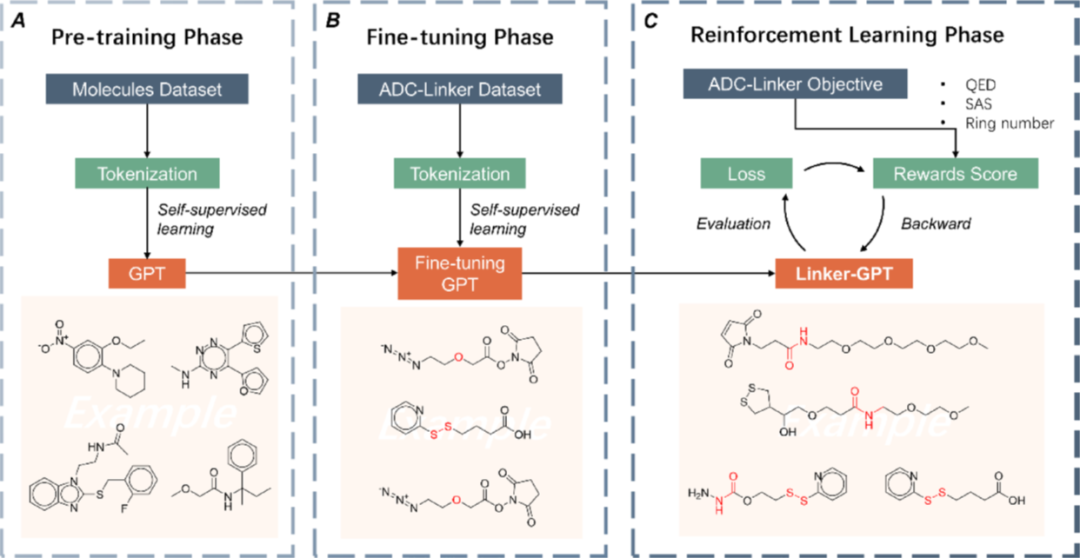
Figure 1. Linker-GPT workflow: pre-training (A), fine-tuning (B), and reinforcement learning (C).
| 89.4% | 99.7% | 98.7% |
|---|---|---|
| Valid generated molecules | Novel generated molecules | Met optimized screening thresholds |
Reported computational metrics: validity and novelty after transfer learning; the 98.7% value refers to generated molecules meeting the study’s QED, LogP, and synthetic-accessibility-score thresholds after reinforcement learning.[4]
These results suggest that generative AI can propose candidate linkers beyond familiar scaffolds and expand early-stage screening options. However, a chemically valid generated structure is not an experimentally validated ADC linker. The reported metrics do not establish synthesis success, plasma stability, release kinetics, or in vivo safety in an actual ADC system.
Linker and payload optimization also cannot be treated as entirely independent tasks. Payload properties can affect conjugation efficiency and ADC hydrophobicity, while linker chemistry influences release and exposure. Future models will need to integrate payload characteristics, conjugation compatibility, and whole-ADC developability into multi-objective evaluation.[1–3]
3. Can Machine Learning Improve ADC Conjugation Process Development?
A 2025 study by Angiolini and colleagues applied the XGBoost machine-learning algorithm to predict DAR from data related to antibodies, amino-acid residues, and linker–payload systems. The authors developed models for lysine- and cysteine-based conjugation datasets and reported coefficients of determination (R²) of 0.85 and 0.95, respectively.[5]
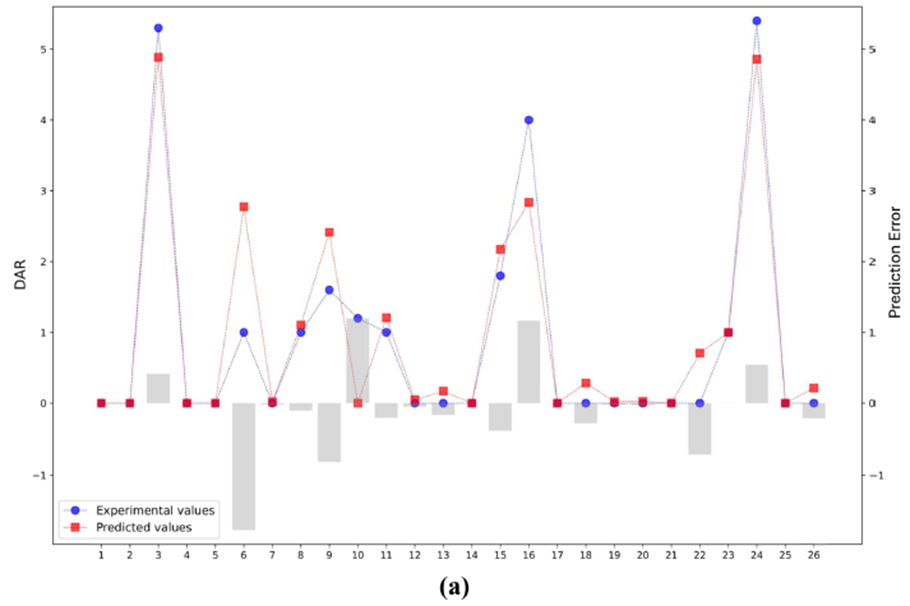
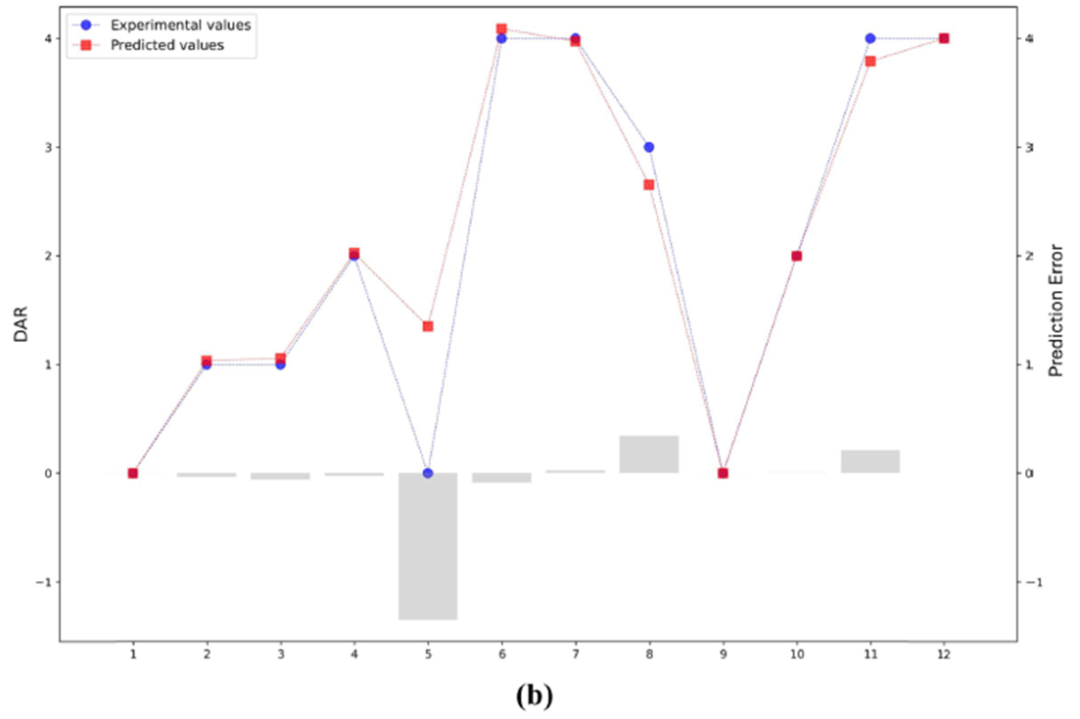
Figure 2. Comparison of predicted and experimental DAR values for lysine (a) and cysteine (b) bioconjugation.
| R² = 0.85 | R² = 0.95 |
|---|---|
| Lysine-conjugation dataset | Cysteine-conjugation dataset |
R² (coefficient of determination) measures how much variation in the observed outcome is explained by the model on the evaluated dataset; values closer to 1 generally indicate better fit. These results are not industrial process success rates.[5]
Learning from historical conjugation experiments could help researchers prioritize antibody–linker–payload combinations and experimental conditions, potentially reducing low-value screening. Yet average DAR is only one product attribute: samples with similar average DAR may differ in DAR distribution, site occupancy, aggregation, and other critical quality attributes.
Model performance also depends on the coverage and quality of training data. Predictions for new antibodies, conjugation chemistries, or substantially different process conditions require experimental confirmation. For now, AI is better positioned as a decision-support tool within process development than as a replacement for laboratory work.
4. What Comes Next for AI-Enabled ADC Development?
Recent literature points to three connected directions: (1) integrated modeling of antibodies, linkers, payloads, conjugation sites, and DAR rather than isolated parameters; (2) improved developability prediction through combined structural simulation, analytical characterization, and biological data; and (3) iterative design–make–test–learn workflows linking AI-generated hypotheses with synthesis, conjugation, analysis, and feedback.[1–3]
Complex formats such as dual-payload ADCs and bispecific ADCs may benefit from these approaches, but limited high-quality, format-specific datasets remain a major constraint. Their practical value will depend on prospective validation in relevant experimental systems.
5. From AI-Generated Designs to Manufacturable ADCs: The Role of CRDMO Capabilities
AI may accelerate candidate generation and parameter prediction, but converting computational outputs into viable ADC programs requires experimental and process validation. Novel linker–payload candidates need synthesis, purification, structural confirmation, and assessment of stability, release behavior, and conjugation compatibility. AI-assisted conjugation strategies likewise require testing of DAR distribution, purity, aggregation, reproducibility, and critical quality attributes during scale-up.
ChemExpress brings complex organic synthesis expertise together with an integrated ADC CRDMO service offering spanning antibodies, linkers, payloads, conjugation, and sterile fill–finish. Its capabilities in linker–payload synthesis, conjugation process development, analytical characterization, and cGMP-related manufacturing activities can help customers experimentally evaluate promising designs and advance suitable candidates through subsequent development stages.
As AI becomes more widely used in ADC R&D, the ability to translate innovative molecular concepts into reproducible, scalable processes will remain essential to successful development and manufacturing.
Conclusion: AI Is Promising, but Experimental Evidence Remains Decisive
Linker-GPT and machine-learning DAR prediction demonstrate that AI can expand chemical design options and support quantitative process prediction. They do not yet show that AI can independently resolve the full set of ADC development and manufacturing challenges. The most promising direction is closer integration of computational models, chemical synthesis, conjugation development, and high-quality experimental data—with manufacturability and experimental verification remaining central to translation.
Frequently Asked Questions
What data are needed to train useful AI models for ADC development?
Useful datasets should connect well-defined molecular structures and conjugation conditions with measured outputs, such as DAR and its distribution, stability, aggregation, and analytical results. Consistent experimental methods and clear metadata are essential for assessing whether predictions transfer to new systems.
Can AI-generated ADC linkers be used directly in drug development?
No. Generated structures are starting points for evaluation. Researchers must establish synthetic feasibility and experimentally assess their performance in the intended linker–payload and ADC context before advancing them.
Does a high DAR prediction R² mean the conjugation process is optimized?
No. R² describes predictive fit on the evaluated dataset. Process optimization also requires control of product heterogeneity, impurity profiles, aggregation, reproducibility, and scale-up performance.
How can an ADC CRDMO support AI-assisted drug development?
An ADC CRDMO can translate selected computational candidates into testable materials, develop and characterize conjugation processes, and evaluate whether promising designs can meet development and manufacturing requirements. Such work complements, rather than validates by itself, an AI model.
References
1. Artificial intelligence in antibody–drug conjugate development. Trends in Pharmacological Sciences (2025).
2. Harnessing computational technologies to facilitate antibody–drug conjugate development. Nature Chemical Biology (2025), 21:1138–1147.
3. Leveraging
artificial intelligence in antibody-drug conjugate development: from target identification to clinical
translation in oncology
. npj Precision Oncology (2025).
4. Linker-GPT: design of Antibody-drug conjugates linkers with molecular generators and reinforcement learning. Scientific Reports (2025), 15:20525.
5. Machine Learning for Predicting the Drug-to-Antibody Ratio (DAR) in the Synthesis of Antibody–Drug Conjugates (ADCs). Journal of Chemical Information and Modeling (2025), 65:5847–5855.
Tags:
AI in ADC Development ADC Linker–Payload Design Linker-GPT Drug-to-Antibody Ratio Conjugation Process Development ADC CRDMO