

From Bispecific to Multifunctional Antibodies: Where Is Next-Generation Antibody Therapeutics Innovation Heading?
From Bispecific to Multifunctional Antibodies: Where Is Next-Generation Antibody Therapeutics Innovation Heading?
Executive Summary
Next-generation antibody therapeutics are moving beyond single-target recognition toward programmable control of signaling, immune-cell engagement and tissue-selective activity. Clinically validated T-cell engagers (TCEs) now coexist with emerging trispecific, immune-cell-engaging and conditionally activated platforms. The critical differentiator is not the number of binding domains, but demonstrable clinical benefit, an acceptable therapeutic window and manufacturability.
Introduction: From Precise Recognition to Precise Biological Control
Therapeutic antibodies have evolved from conventional monoclonal antibodies (mAbs) into a broad class of bispecific, multispecific and other engineered modalities. Although conventional mAbs have transformed oncology and autoimmune disease care, target-mediated resistance, immune escape and the immunosuppressive tumor microenvironment remain important limitations.
Modern antibody engineering enables dual-pathway blockade, immune-cell recruitment, checkpoint modulation and conditional activation within a single molecule. Innovation is increasingly defined by precise control of target engagement, immune activation and tissue selectivity rather than by target count alone. This article examines the major platforms, representative clinical programs and development challenges, with an emphasis on non-antibody-drug conjugate (non-ADC) modalities.
1. What Are Next-Generation Antibodies?
1.1 Definition and scope
“Next-generation antibodies” is an umbrella term, not a harmonized regulatory drug class. It encompasses therapeutics engineered beyond conventional mAbs in molecular architecture or function, including Fc-engineered antibodies, bispecific and multispecific antibodies, single-domain antibodies, antibody fragments and conditionally active constructs.
Three concepts should be distinguished: specificity is the number of distinct antigens or epitopes recognized; valency is the number of antigen-binding sites; and a functional module is a domain that confers additional biological activity. For example, glofitamab has a 2:1 binding configuration but remains a CD20×CD3 bispecific antibody.
1.2 Structural formats
| Format | Principal features | Advantages and development considerations |
|---|---|---|
| IgG-like | Full-length or engineered Fc; symmetric or asymmetric architectures | Typically longer half-life; chain pairing and structural complexity require control |
| Non-IgG-like | Assemblies of scFv, Fab or single-domain modules | Compact and flexible; some formats have shorter systemic exposure |
| Multivalent / multispecific | 2:1, 2:2 and higher-order binding arrangements | Potential avidity and functional synergy; greater CMC complexity |
Knobs-into-Holes, CrossMab and DuoBody are examples of engineering approaches that facilitate heavy-chain heterodimerization, correct light-chain pairing or controlled Fab-arm exchange.
1.3 Functional classification
| Platform | Primary mechanism |
|---|---|
| Dual-pathway blockade / biparatopic binding | Inhibit compensatory pathways or engage distinct epitopes on one receptor |
| Immune cell engagers (ICEs) | Recruit T cells, NK cells or macrophages to eliminate target cells |
| Immune modulation / agonistic antibodies | Block inhibitory checkpoints or activate costimulatory receptors |
| Multispecific / multifunctional antibodies | Combine three or more binding specificities or functional elements |
| Conditionally active antibodies | Restrict binding or activation to selected tissue microenvironments |
These categories overlap. A trispecific TCE is both a multispecific antibody and an immune-cell engager; conditional activation can be incorporated into multiple molecular formats.
2. How Did Antibody Therapeutics Evolve?
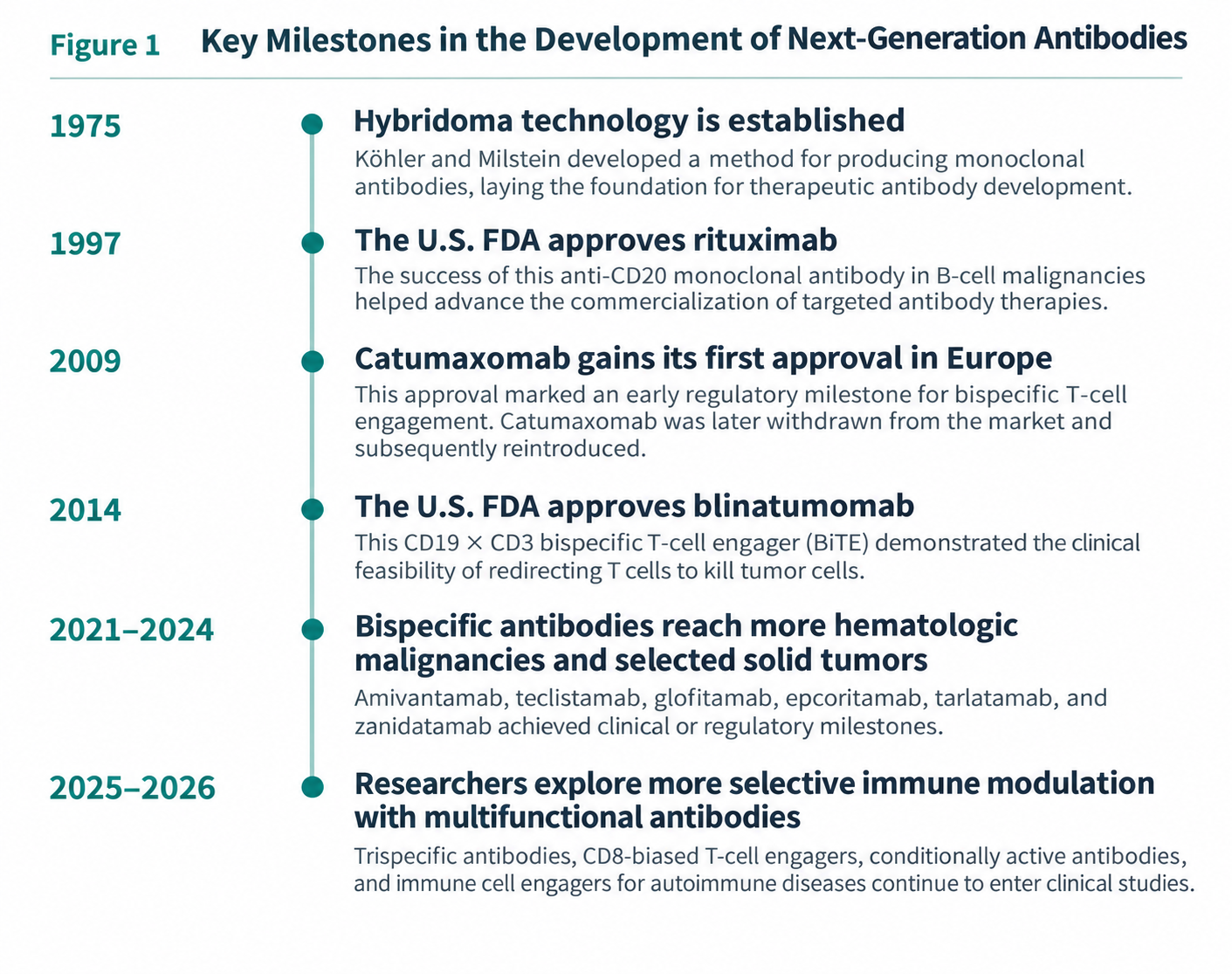
Figure 1. Key milestones in the evolution of next-generation antibodies. This chronology is a selective overview rather than a comprehensive approval history.
The central shift is from improving antigen recognition, humanization and pharmacokinetics toward engineering spatially coordinated interactions among cells and signaling pathways. More binding domains are valuable only when they address a defined biological limitation, such as antigen escape, compensatory signaling or insufficient immune-cell recruitment.
3. Five Major Innovation Platforms
3.1 Dual-pathway blockade and biparatopic recognition
Dual-pathway blockade seeks to counter bypass signaling and compensatory mechanisms. Amivantamab (EGFR×MET) inhibits receptor signaling and can promote receptor downregulation and Fc-mediated immune effects. Ivonescimab (PD-1×VEGF) combines immune-checkpoint blockade with modulation of VEGF-associated angiogenesis and immunosuppression. Zanidatamab recognizes two distinct HER2 epitopes, enabling receptor clustering, internalization and functional modulation. Clinical benefit must be demonstrated rather than inferred from target pairing alone.
3.2 Immune cell engagers (ICEs)
ICEs bridge disease-associated target cells and immune effector cells. T-cell engagers (TCEs) generally bind CD3 and a tumor-associated antigen, inducing T-cell-mediated cytotoxicity; blinatumomab, glofitamab and teclistamab have established clinical precedents in hematologic cancers. NK-cell engagers (NKCEs) recruit NK cells through receptors such as CD16A or NKp46; some designs include IL-15-related functions. Macrophage-engaging approaches aim to enhance phagocytosis, including through modulation of the CD47–SIRPα axis. NK- and macrophage-engaging platforms are generally less clinically mature than TCEs.
3.3 Immune-checkpoint and costimulatory modulation
Immunomodulatory bispecifics may target PD-1, CTLA-4 or TIGIT in combination, or pair checkpoint blockade with costimulatory signaling through 4-1BB (CD137), CD28 or OX40. A major design consideration is where and how strongly immune activation occurs: excessive systemic agonism can cause toxicity, making target-dependent, localized costimulation an important research strategy.
3.4 Trispecific and multifunctional antibodies
Trispecific antibodies can combine two tumor-associated antigens with CD3 to address certain antigen-escape mechanisms. Ramantamig (JNJ-79635322), targeting BCMA×GPRC5D×CD3, exemplifies this approach. Other constructs integrate tumor targeting, immune recruitment and costimulation. Their success depends on balancing binding affinity, valency, stability, correct assembly and clinically meaningful incremental benefit.
3.5 Conditionally active antibodies
Conditional activation seeks to reduce systemic activity while restoring function in disease tissue, using mechanisms such as protease-cleavable masking domains or pH-dependent binding. Masked TCEs may widen the therapeutic window, but activation efficiency, tumor heterogeneity and unintended activation in inflamed normal tissue remain important questions.
4. Global Clinical Pipeline and Competitive Landscape
4.1 Representative approved and late-stage programs
| Modality | Therapeutic / developer | Targets | Indication | Reported status |
|---|---|---|---|---|
| Dual-pathway | Amivantamab / Johnson & Johnson | EGFR×MET | EGFR-mutant NSCLC | Approved |
| Dual-pathway | Ivonescimab / Akeso; Summit | PD-1×VEGF | NSCLC | Approved in China; global Phase III |
| Biparatopic | Zanidatamab / Zymeworks; Jazz | Two HER2 epitopes | HER2-positive biliary tract cancer | US accelerated approval |
| TCE | Blinatumomab / Amgen | CD19×CD3 | B-ALL | Approved |
| TCE | Mosunetuzumab / Roche | CD20×CD3 | Follicular lymphoma | Approved |
| TCE | Glofitamab / Roche | CD20×CD3 | Large B-cell lymphoma | Approved |
| TCE | Epcoritamab / Genmab; AbbVie | CD20×CD3 | B-cell lymphoma | Approved |
| TCE | Teclistamab / J&J | BCMA×CD3 | Multiple myeloma | Approved |
| TCE | Elranatamab / Pfizer | BCMA×CD3 | Multiple myeloma | Approved |
| TCE | Talquetamab / J&J | GPRC5D×CD3 | Multiple myeloma | Approved |
| TCE | Linvoseltamab / Regeneron | BCMA×CD3 | Multiple myeloma | US accelerated approval (2025) |
| TCE | Tarlatamab / Amgen | DLL3×CD3 | Extensive-stage SCLC | Approved |
| Trispecific TCE | Ramantamig / J&J | BCMA×GPRC5D×CD3 | Multiple myeloma | Phase III program |
Approval is indication- and jurisdiction-specific. Ivonescimab is commercialized in China and remains under global Phase III development; its initial US biologics license application received an FDA complete response letter in November 2026, while other clinical studies continue. The development status of ramantamig refers to a pivotal comparative program.
4.2 Clinical exploration of ICEs in autoimmune diseases
| Program / developer | Targets | Key indications | Highest reported stage |
|---|---|---|---|
| Surovatamig (AZD0486) / AstraZeneca | CD19×CD3 | SLE; RA | Phase I |
| CLN-978 / Cullinan | CD19×CD3; albumin-binding module | SLE; RA; Sjögren disease | Phase I |
| RG-6382 (RO7507062) / Roche | CD19×CD3 | SLE | Discontinued; reached Phase I |
| Cizutamig (CND106) / UCB (formerly Candid) | BCMA×CD3 | Autoimmune diseases | Phase I; Phase II planned for late 2026 |
| CND-261 (GB261) / UCB (formerly Candid) | CD20×CD3 | SLE; RA | Phase Ib |
| AZD-5492 / AstraZeneca | CD20×CD8×TCR | SLE; RA; other conditions | Phase I |
| CC312 / CytoCares | CD19×CD28×CD3 | SLE and others | Phase I |
| GSK-5926371 / GSK | CD19×CD20×CD3 | SLE; RA and others | Phase I |
The B-cell differentiation stage determines target coverage: CD20 is mainly associated with mature B cells, CD19 spans a broader B-cell lineage, and BCMA is important in plasmablasts and plasma cells. Autoimmune ICEs therefore require indication-specific strategies for pathogenic-cell depletion, immune reconstitution and long-term safety. Development stages are based on publicly reported status as of November 2026; planned trials are not treated as initiated.
5. What Clinical Advances Have Next-Generation Antibodies Delivered?
5.1 Hematologic malignancies: an established foundation for TCEs
TCEs targeting CD19×CD3, CD20×CD3, BCMA×CD3 and GPRC5D×CD3 have yielded approved therapies for B-ALL, B-cell lymphomas and multiple myeloma. The US accelerated approval of linvoseltamab in 2025 broadened BCMA-directed options. As the class expands, differentiation increasingly depends on duration of response, infections, neurologic adverse events, dosing schedules and patient burden. Objective response rates from separate single-arm studies should not be ranked as if they were head-to-head results.
5.2 Solid tumors: dual-targeting and T-cell redirection
Amivantamab and zanidatamab demonstrate the clinical utility of dual-pathway blockade and biparatopic recognition in selected solid tumors. The DLL3×CD3 TCE tarlatamab has also achieved regulatory success in extensive-stage small-cell lung cancer, showing that T-cell redirection is not confined to hematologic malignancies. Nevertheless, antigen heterogeneity, normal-tissue expression, inadequate effector-cell infiltration and immunosuppressive tumor microenvironments continue to constrain broader translation.
5.3 Autoimmune diseases: deep B-cell depletion as an emerging strategy
Small studies of CD19×CD3 and BCMA×CD3 TCEs in refractory autoimmune diseases have reported depletion of relevant target-cell populations, reductions in autoantibody levels and improvement in some clinical manifestations. These early signals support further investigation of deep B-cell depletion in patients inadequately controlled by conventional immunosuppression. Long-term benefit remains unproven and requires controlled clinical evaluation.
5.4 Improving therapeutic windows and treatment convenience
Longer-lived IgG-like formats, step-up dosing, premedication, subcutaneous administration and affinity tuning can support more manageable treatment regimens for selected TCEs. Clinical differentiation increasingly depends on achieving durable benefit while controlling toxicity and reducing treatment burden.
6. Key Challenges and Future Outlook
Three obstacles remain central: cytokine release syndrome (CRS), immune effector cell-associated neurotoxicity syndrome (ICANS) and on-target/off-tumor toxicity; heterogeneous antigens and immunosuppressive microenvironments in solid tumors; and the CMC demands of chain pairing, aggregation, stability and analytical characterization in complex formats.
Future innovation will emphasize conditional activation, CD8-biased engagement and affinity tuning to improve selectivity; multispecific designs that demonstrate measurable incremental benefit; and earlier integration of AI-assisted protein design, developability assessment, process development and quality control. Expansion into autoimmune diseases will require especially careful assessment of immune reconstitution and long-term infection risk.
Conclusion: Innovation Is More Than Adding Targets
Antibody therapeutics are evolving from single-target recognition agents into multifunctional precision platforms. TCEs have established a clinical foothold in hematologic malignancies; selected bispecifics have advanced solid-tumor treatment; and trispecific and next-generation ICE platforms are extending the frontier. The true measure of innovation is whether an engineered mechanism delivers reproducible clinical benefit with acceptable safety and scalable manufacturing.
Chongqing Haoyuan, a ChemExpress-controlled subsidiary, focuses on biologics including monoclonal, bispecific and multispecific antibodies and recombinant proteins. Its integrated CDMO services span early development, cell-line development, upstream cell culture, downstream purification, analytical method development, formulation development, technology transfer, GMP manufacturing and fill-finish. These capabilities support the translation of complex antibody candidates from research through clinical development and manufacturing scale-up.
Frequently Asked Questions
What makes a next-generation antibody different from a conventional monoclonal antibody?
It may incorporate multiple antigen-binding specificities, engineered signaling functions, selective immune-cell recruitment or conditional activation rather than relying primarily on single-target recognition.
Are bispecific antibodies and T-cell engagers the same?
No. TCEs are a functional subset of immune-cell-engaging molecules, frequently built as bispecific antibodies. Many bispecifics do not recruit T cells.
Why are trispecific antibodies being developed?
They may address antigen escape or combine targeting and immune activation, but their added complexity must be justified by comparative clinical benefit.
Which non-ADC antibody platforms are clinically most established?
CD3-directed TCEs in hematologic malignancies and selected dual-targeting antibodies in solid tumors have the strongest established clinical precedent among the platforms discussed here.
What are the main manufacturing challenges for multispecific antibodies?
Correct chain pairing, product heterogeneity, aggregation, stability, analytical characterization and reproducible scale-up are key CMC considerations.
References and Further Reading
- Fontana E, et al. Evolution of bispecific and multispecific antibodies in cancer therapy. The Lancet Regional Health – Europe. 2026.
- Liu W-Q, et al. Harnessing multispecific antibodies for next-generation cancer treatments. Pharmacology & Therapeutics. 2026.
- Fu Y, et al. Next-generation immune cell engagers for B cell depletion in autoimmune diseases. Nature Reviews Drug Discovery. 2026.
- Grieshaber-Bouyer R, et al. T cell engagers in autoimmune diseases. Nature Reviews Immunology. 2026.
- Jiao G, et al. Landscape of T-cell bispecific antibodies in cancer therapy. Molecular Cancer. 2026;25:189.
- Summit Therapeutics. Update Regarding Ivonescimab Biologics License Application. 2026-11-15.